
Cultural safety in funding applications for AAT refers to the explicit demonstration of how Animal Assisted Therapy programs align with Te Tiriti o Waitangi principles and indigenous models of health. It requires applicants to articulate how therapy animals support holistic wellbeing (Hauora) and facilitate culturally responsive care for diverse populations, particularly Māori and Pasifika communities.
Securing government or philanthropic funding for Animal Assisted Therapy (AAT) in New Zealand is becoming increasingly competitive. Whether you are applying to the Ministry of Education (MOE), the Ministry of Health (MOH), or private trusts, the deciding factor is frequently the quality of your cultural safety narrative. It is no longer sufficient to simply state that your practice is “inclusive.” Evaluators require rigorous evidence that your AAT modalities honor the bi-cultural partnership of Aotearoa and provide safe, effective environments for all service users.
Why AAT Funding Applications Get Rejected
The rejection of funding applications for Animal Assisted Therapy often stems from a disconnect between clinical intentions and policy requirements regarding cultural safety. While the therapeutic efficacy of AAT is well-documented, funding bodies in New Zealand prioritize providers who demonstrate systemic cultural competence.

The “Generic Inclusion” Trap
A primary reason for rejection is the use of generic inclusion statements. Phrases such as “we welcome everyone” or “we treat all clients equally” are red flags for evaluators. These statements imply a lack of awareness regarding the specific historical and systemic inequities faced by Māori and Pasifika populations. Funding bodies look for equity, not equality. They want to know how your AAT program actively dismantles barriers to access and creates a space where cultural identity is validated.
Failure to Reference Te Tiriti o Waitangi
In the New Zealand context, any application to the MOE or MOH that does not explicitly reference the principles of Te Tiriti o Waitangi (Partnership, Protection, and Participation) is likely to be declined. A common mistake is referencing these principles in the abstract without linking them to specific operational practices within the AAT setting. For example, failing to explain how the presence of a therapy animal facilitates Whanaungatanga (relationship building) or how the program protects the Mana of the client.
Lack of Community Consultation
Commercial intent often drives providers to develop programs in isolation. However, funding requires proof of community need and consultation. Applications often fail because the provider has not engaged with local Iwi, Marae, or community leaders to co-design the service. If your AAT program is imposed upon a community rather than developed with it, it fails the cultural safety test.
Writing the Cultural Alignment Section
The cultural alignment section is arguably the most critical component of your funding application. This is where you translate your clinical expertise into a culturally responsive framework. This section must move beyond tokenism and demonstrate deep integration of indigenous health models.
Integrating Te Whare Tapa Whā
One of the most effective ways to demonstrate cultural safety in AAT is to map your services against the Te Whare Tapa Whā model of health. This model views health as a four-walled house, where all walls must be strong for the house to stand.
- Taha Tinana (Physical Health): Describe how handling, walking, or grooming the therapy animal promotes physical activity and fine motor skills.
- Taha Hinengaro (Mental Health): articulate how the animal provides non-judgmental support, reducing anxiety and allowing clients to process trauma without the pressure of direct eye contact or verbalization.
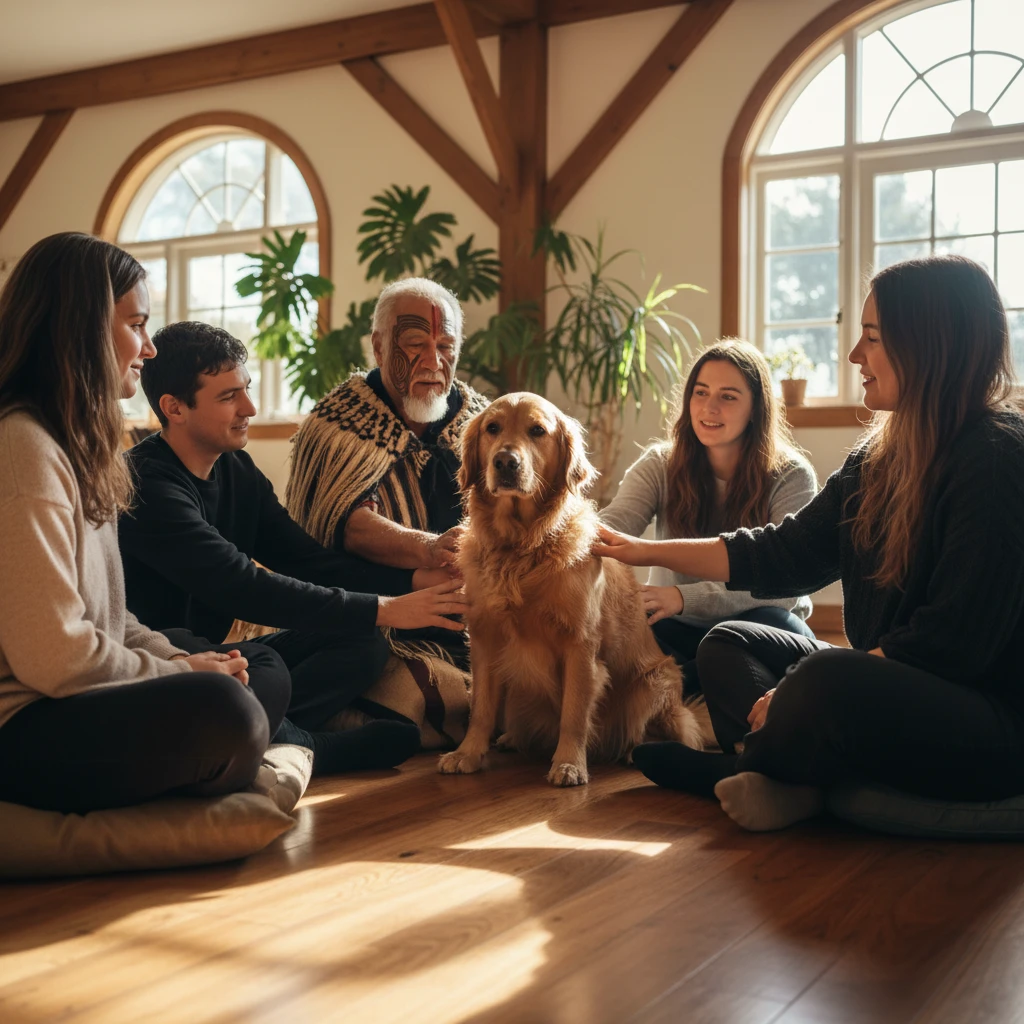
- Taha Wairua (Spiritual Health): This is often overlooked in Western clinical applications but is vital for cultural safety. Explain how the connection between the human and the animal respects the spiritual interconnectedness of all living things. Animals can often reach the Wairua of a client in ways human therapists cannot.
- Taha Whānau (Family Health): Detail how your AAT program involves the wider family unit. Does the therapy dog help bridge communication gaps between a child and their parents?
Applying the Fonofale Model for Pasifika Communities
If your target demographic includes Pasifika communities, your application should reference the Fonofale model. This involves addressing the roof (Culture), the foundation (Family), and the posts (Physical, Spiritual, Mental, and Other). Specifically, highlight how AAT respects the collective nature of Pasifika cultures. Therapy should not be isolated to the individual but should be framed as a benefit to the collective family and community structure.
Evidence-Based Outcomes for Diverse Groups
To win commercial contracts or government grants, you must prove that your cultural safety protocols lead to better outcomes. Data is essential, but it must be the right kind of data.
Qualitative vs. Quantitative Metrics
While quantitative data (e.g., reduction in anxiety scores) is important, culturally safe reporting places high value on qualitative narrative. Include case studies that highlight the client’s journey. Use quotes and feedback from whānau to demonstrate the impact of the service. For example, rather than just stating “attendance improved by 20%,” include a testimonial stating, “The presence of the therapy dog made my son feel safe enough to enter the room, something he hasn’t done in months.”
Longitudinal Cultural Impact
Evaluators are looking for sustainable change. Your application should outline how you measure long-term engagement with diverse groups. Are Māori clients staying in therapy longer because of the AAT intervention? Do you have lower dropout rates among Pasifika youth compared to standard clinical approaches? Highlighting these retention metrics proves that your cultural safety strategy is working operationally, not just theoretically.

Templates for MOE and MOH Applications
Writing for the Ministry of Education (MOE) requires a different dialect than writing for the Ministry of Health (MOH). Understanding these nuances is key to a successful commercial outcome for your practice.
Ministry of Education (MOE) Focus
When applying for MOE funding (such as Learning Support funding), your language must pivot toward participation and learning outcomes.
- Keywords to use: Inclusive education, barrier reduction, neurodiversity, engagement, attendance, emotional regulation for learning.
- The Narrative: Frame the AAT intervention as a tool that regulates the student’s nervous system, thereby making them “ready to learn.” The cultural safety aspect here focuses on how the animal helps tamariki Māori engage with the curriculum in a way that aligns with their identity.
- Template Tip: Structure your proposal to directly answer how the service supports the goals of the student’s Individual Education Plan (IEP).
Ministry of Health (MOH) Focus
MOH applications focus on clinical efficacy, risk reduction, and Hauora.
- Keywords to use: Psychosocial functioning, trauma-informed care, reduction in acute distress, biological-psychological-social determinants of health.
- The Narrative: Position AAT as a complementary therapy that enhances the effectiveness of standard treatments. Cultural safety here is about reducing health inequities. You must argue that AAT provides an entry point for populations that historically distrust the clinical health system.
- Template Tip: Use a “Problem, Intervention, Outcome, Cultural Rationale” structure for every funding line item requested.

Leveraging Animals as Cultural Bridges
Finally, do not underestimate the power of the animal itself in your cultural safety narrative. In many indigenous worldviews, animals are not “tools” but sentient beings with their own mana.
Your application should reflect an ethical framework that honors the animal’s agency. This aligns with the concept of Kaitiakitanga (guardianship). By demonstrating that your AAT practice respects the welfare and mana of the animal, you inherently demonstrate a worldview that resonates with Māori values. This distinguishes your application from those that view the animal merely as clinical equipment.
Furthermore, animals act as social lubricants that bypass cultural and linguistic barriers. They offer a universal language of touch and presence. Highlighting this “universal bridge” capability, while acknowledging specific cultural contexts, creates a compelling argument for funding.
People Also Ask
What is cultural safety in the context of NZ funding?
Cultural safety in NZ funding means demonstrating that your service recognizes and respects the cultural identities of others, specifically upholding Te Tiriti o Waitangi obligations and ensuring services do not demean or disempower Māori or other cultural groups.
How do I include Te Tiriti o Waitangi in my AAT application?
You must give practical examples of the three Ps: Partnership (working with whānau), Protection (ensuring cultural and physical safety), and Participation (ensuring equal access to outcomes) within your therapy sessions.
Can I get MOE funding for a therapy dog in schools?
Yes, but usually through Learning Support funding or specific pastoral care grants. You must prove the dog directly supports learning outcomes, attendance, or emotional regulation for neurodiverse students.
What evidence is needed for AAT funding approval?
You need a mix of quantitative data (attendance rates, anxiety scales) and qualitative data (whānau feedback, case studies). Crucially, you need evidence of cultural responsiveness and community engagement.
Why was my AAT grant application declined?
Common reasons include a lack of specific cultural safety strategies, generic answers regarding diversity, insufficient evidence of clinical outcomes, or failing to align with the specific strategic goals of the funding body.
How does AAT support Te Whare Tapa Whā?
AAT supports Taha Tinana through physical interaction, Taha Hinengaro through emotional support, Taha Wairua through spiritual connection with nature, and Taha Whānau by facilitating family engagement in therapy.