
Bicultural practice guidelines in AAT NZ refer to the integration of Tikanga Māori values and Te Tiriti o Waitangi principles into animal-assisted therapy. This ensures culturally safe environments where therapy dogs and handlers respect tapu (sacredness), build whanaungatanga (relationships), and utilize Te Reo Māori commands to honor the dual heritage of Aotearoa.
In the unique context of Aotearoa New Zealand, Animal Assisted Therapy (AAT) extends beyond the clinical bond between human and animal. It requires a profound commitment to biculturalism, acknowledging the partnership between Tangata Whenua (Māori) and Tangata Tiriti (people of the Treaty). For handlers, this means that clinical competence must be matched by cultural competence. Implementing bicultural practice guidelines is not merely a box-ticking exercise; it is an essential component of providing effective, respectful, and holistic care.
What are the Foundations of Bicultural Practice in AAT?
To practice effectively in New Zealand, AAT handlers must ground their work in the principles of Te Tiriti o Waitangi. This involves understanding the three ‘P’s: Partnership, Protection, and Participation. In the context of therapy dogs, this translates to working with Māori clients rather than delivering services to them, protecting their cultural concepts of health, and ensuring they have active participation in how the therapy is structured.
Understanding the Māori worldview is critical. In Western therapy models, the dog is often viewed as a tool or a co-therapist used to achieve a specific clinical outcome. In Te Ao Māori (the Māori world), the dog (kurī) can be seen as a connector to nature, a spiritual guardian, or a bridge to discuss ancestry and connection. However, historical contexts vary, and handlers must be sensitive to the fact that not all whānau may view dogs inside a meeting space as culturally appropriate.
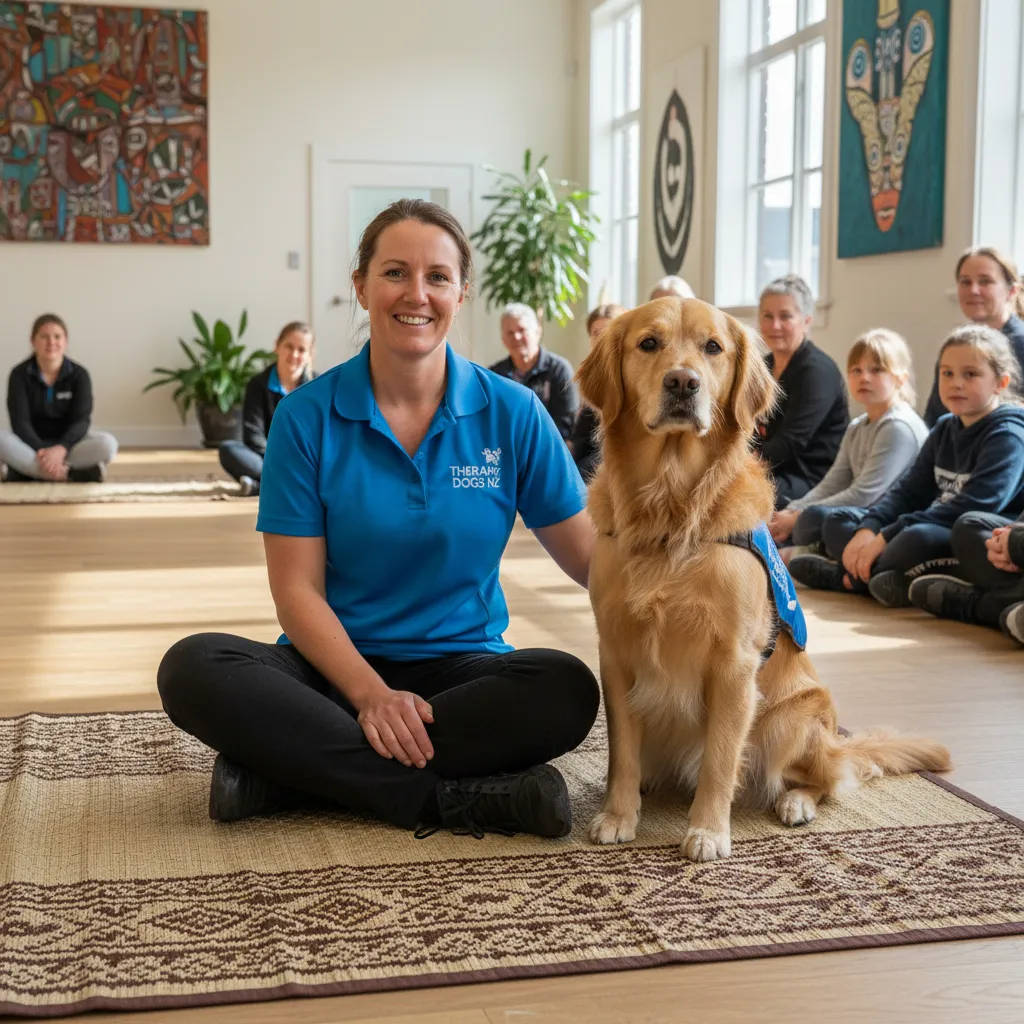
How to Build Whanaungatanga in Therapy Sessions
Whanaungatanga is the process of establishing relationships and relating well to others. In a standard clinical setting, a professional might jump straight into assessment or treatment. In a bicultural AAT context, this is often considered ineffective or even rude. The priority must be connection.
The Process of Connection
Before introducing the dog to the work, the handler must introduce themselves and the dog in a way that establishes connection. This often involves sharing one’s mihi (introduction) appropriately. Sharing where you are from (your mountain, your river) allows the client to find common ground.
The Dog’s Whakapapa
An excellent way to build rapport is to share the dog’s whakapapa (genealogy/lineage). Discussing the dog’s parents, their breed history, and their training journey parallels the importance of lineage in Māori culture. It frames the dog not just as an animal, but as a being with a history and a place in the world. This narrative approach aligns with the oral traditions of storytelling and helps settle the mauri (life force) of the room before clinical work begins.
Implementing Te Reo Māori Commands for Dogs
Language is the vehicle of culture. Integrating Te Reo Māori commands into your dog’s repertoire is a powerful signal of respect and inclusivity. It demonstrates to the client that the handler values the indigenous language of New Zealand. Furthermore, many dogs respond exceptionally well to the vowel-heavy, rhythmic nature of Te Reo Māori.
Below is a guide to essential commands for the bicultural handler. It is vital that handlers practice the correct pronunciation (using long and short vowels) to uphold the mana of the language.
Core Commands
- E noho (Sit): Pronounced ‘Eh naw-haw’. Used for settling the dog.
- Haere mai (Come): Pronounced ‘High-reh my’. A welcoming command for recall.
- Taihoa (Wait/Hold on): Pronounced ‘Tie-ho-ah’. Essential for impulse control and safety.
- Takoto (Lie down): Pronounced ‘Tah-kaw-taw’. Used for relaxing the dog during counseling.
- Titiro (Look/Watch): Pronounced ‘Tee-tee-raw’. Used for engagement and focus.
When a client hears a handler speak Te Reo to their animal, it often lowers barriers. It can empower the client to give commands in Te Reo themselves, fostering a sense of ownership and capability (mana motuhake) within the session.

Understanding Tapu and Noa: Spiritual Safety
The concepts of Tapu (sacred/restricted) and Noa (common/free from restriction) are fundamental to navigating spaces safely in Aotearoa. Ignorance of these can cause spiritual offense and damage the therapeutic relationship.
The Head is Tapu
In Māori culture, the head is considered the most sacred part of the body. Handlers must be vigilant that their therapy dogs do not lick a client’s face or head. While some Western clients might find a “dog kiss” endearing, in a bicultural context, a dog licking the face can be seen as diminishing the tapu of the person. Handlers should train dogs to target hands or knees for affection, keeping the head safe.
Food and Spaces
Food is noa and is used to lift tapu. However, mixing food with things that are tapu (like bodily fluids or washrooms) is prohibited. In AAT:
- Do not place dog treats on tables used for human food or medication.
- Ensure the dog’s water and food bowls are washed separately from human dishes (ideally in a laundry or designated area, not the kitchen sink).
- Be mindful of where the dog sits. Tables and pillows for heads are not for dogs’ bottoms.
Applying Te Whare Tapa Whā to AAT
Sir Mason Durie’s model of health, Te Whare Tapa Whā (The Four-Sided House), is the standard for holistic health in NZ. AAT handlers should articulate how the dog supports all four walls of the client’s well-being.
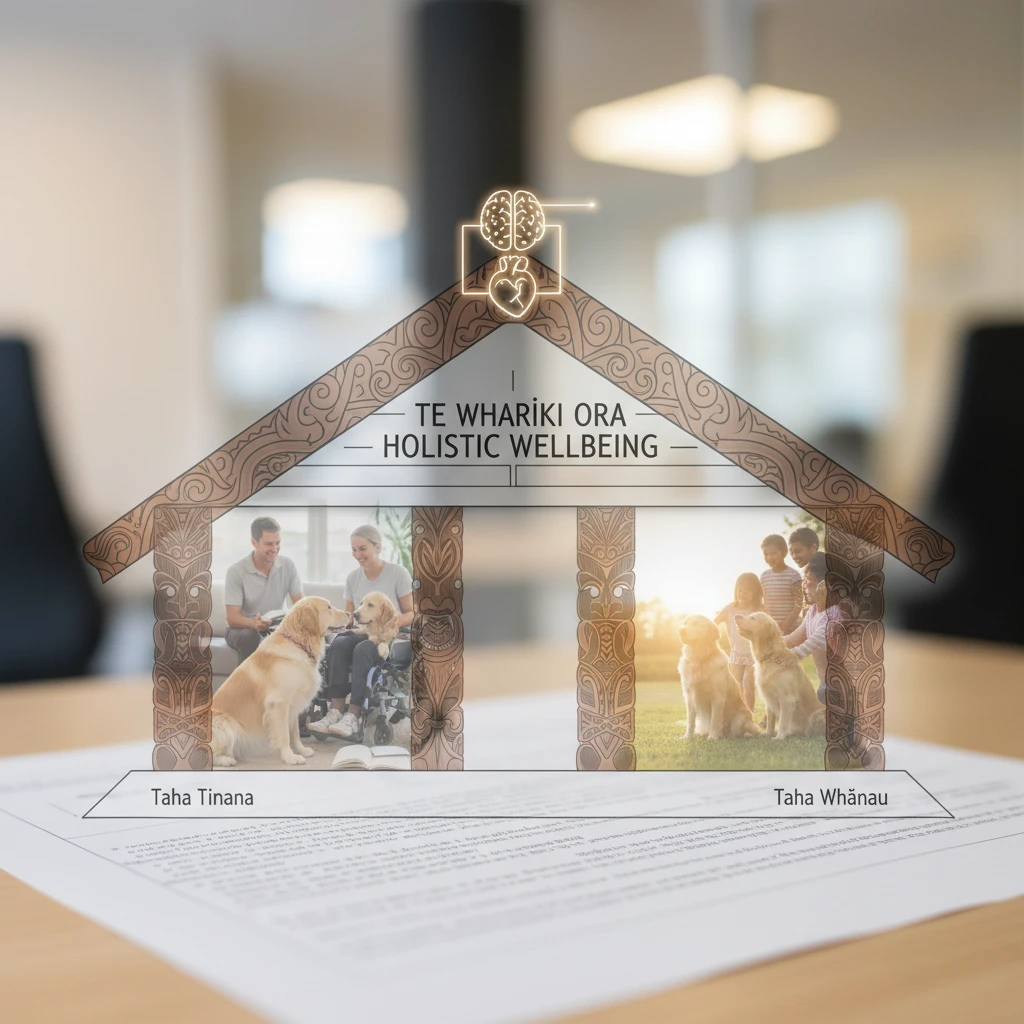
1. Taha Tinana (Physical Health)
The dog encourages movement, walking, and fine motor skills through grooming or petting. This is the physical interaction that grounds the client.
2. Taha Hinengaro (Mental/Emotional Health)
The dog provides non-judgmental support, easing anxiety and allowing for the expression of emotions that might be too difficult to articulate to a human therapist.
3. Taha Wairua (Spiritual Health)
This is often the most overlooked aspect in Western models. Animals have their own wairua. The connection between the client’s spirit and the dog’s spirit can be profound. The dog can serve as a spiritual anchor, providing comfort without words.
4. Taha Whānau (Family Health)
The dog helps reconnect the client to their community and family. In sessions involving family members, the dog acts as a social lubricant, reducing tension and allowing the whānau to interact in a more relaxed manner.
Respectful Engagement with Whānau
In bicultural practice, the client is rarely viewed in isolation; they are part of a whānau system. When bringing a dog into a family setting or a home visit, specific protocols apply.
Manaakitanga (Hospitality and Care)
Manaakitanga is about uplifting the mana of others through generosity and care. When a handler enters a space, they must be prepared to receive manaakitanga (often in the form of tea or food) and eventually reciprocate. The dog must be well-behaved enough to settle while the humans engage in the ritual of eating and talking. If the dog begs or disrupts this process, it disrespects the manaakitanga being offered.
Consent and Safety
Never assume that all whānau members are comfortable with dogs. Some may have trauma or cultural reservations. Always ask for permission before releasing the dog from a lead. “Is it okay for the dog to greet everyone?” is a simple question that shows respect for the space.
Conclusion
Adopting bicultural practice guidelines in Animal Assisted Therapy in New Zealand is a journey, not a destination. It requires continuous reflection, learning, and a willingness to adapt standard dog handling techniques to fit the cultural landscape of Aotearoa. By integrating Te Reo Māori, respecting Tikanga such as tapu and noa, and prioritizing whanaungatanga, handlers can create a therapeutic space that honors the Treaty of Waitangi and provides deep, culturally safe healing for all clients. The therapy dog, when guided by a culturally competent handler, becomes more than a pet—they become a bridge between worlds.
People Also Ask
What are the key bicultural principles in NZ AAT?
The key principles include Whanaungatanga (building relationships), Manaakitanga (care and hospitality), Kotahitanga (unity), and respecting Tapu and Noa (sacredness and safety). These align AAT practice with Te Tiriti o Waitangi obligations.
Why is Te Reo Māori important for dog commands?
Using Te Reo Māori commands honors the indigenous language of New Zealand, shows cultural respect to Māori clients, and helps normalize the language in healthcare settings. It also provides distinct, clear acoustic signals for the dog.
How does the concept of Tapu affect therapy dogs?
Because the head is considered tapu (sacred) in Māori culture, therapy dogs should be trained not to lick faces or heads. Additionally, dog equipment and food (noa) must be kept separate from surfaces used for human food or medication.
What is the best way to introduce a therapy dog to a Māori client?
Start with Whanaungatanga. Introduce yourself and your lineage first, then introduce the dog’s whakapapa (breed history/parentage). Allow time for connection before moving into clinical tasks.
Can dogs enter a Marae for therapy?
This depends entirely on the specific Tikanga of that Marae. Some iwi view dogs as noa or utilitarian and restrict them from the Wharenui (meeting house). Always ask permission from the Kaumātua (elders) well in advance.
How does Te Whare Tapa Whā apply to animal therapy?
The dog supports Taha Tinana (physical touch/movement), Taha Hinengaro (emotional support), Taha Wairua (spiritual connection), and Taha Whānau (social connection), covering all four pillars of Māori health.