
Therapy dogs in schools NZ refers to professionally trained and certified canines integrated into New Zealand educational settings to support student wellbeing, literacy, and emotional regulation. Unlike emotional support animals, these dogs work under specific protocols to provide goal-oriented interventions, helping students manage anxiety, improve reading confidence, and develop social skills within a safe learning environment.
What is Animal Assisted Therapy in NZ Education?
Animal Assisted Therapy (AAT) and Animal Assisted Education (AAE) are rapidly growing fields within the New Zealand education sector. While often used interchangeably in casual conversation, for a school principal or Board of Trustees, the distinction is vital for insurance and policy purposes.
In the context of NZ schools, therapy dogs are not merely pets brought into the classroom. They are selected for specific temperament traits—high tolerance, low reactivity, and sociability—and are often part of a structured program designed to achieve specific educational or therapeutic goals. Whether facilitated by an external organization like Canine Friends Pet Therapy or owned by a staff member who has undergone rigorous training, the dog serves as a co-regulator for students.

The integration of these animals aligns with the New Zealand Curriculum, particularly regarding the Key Competencies of Managing Self and Relating to Others. By interacting with a therapy dog, students learn non-verbal communication, empathy, and emotional regulation techniques that are often difficult to teach through traditional pedagogy.
Evidence-Based Learning Interventions
When justifying the inclusion of a therapy dog to a Board of Trustees or the Ministry of Education (MOE), anecdotal evidence is insufficient. Schools must rely on evidence-based learning interventions to secure approval and funding.
Literacy and Reading Programs
One of the most documented successes of therapy dogs in schools NZ wide is in literacy support. Programs such as “Reading to Dogs” rely on the non-judgmental nature of the animal. When a student reads to a peer or a teacher, they may feel performance anxiety, fearing correction or embarrassment. A dog, however, listens without judgement.
Research indicates that reading to dogs can:
- Lower cortisol levels: Reducing the physiological stress associated with reading difficulties.
- Increase fluency: Students are more likely to read for longer periods when engaged with an animal.
- Boost motivation: The interaction serves as a positive reinforcement loop.
Emotional Regulation and Hauora
Under the Te Whare Tapa Whā model of health, therapy dogs significantly contribute to Taha Hinengaro (mental and emotional health) and Taha Whānau (social health). For neurodiverse students, particularly those on the Autism Spectrum or those with ADHD, a therapy dog can act as a sensory anchor.
The physical act of stroking a dog releases oxytocin (the bonding hormone) and reduces blood pressure. In a crisis situation where a student is dysregulated, the presence of the dog can de-escalate the situation faster than verbal intervention alone, allowing the student to return to a state where learning is possible.
Solutions for Principals: Risk Management and Policy
For Principals and School Boards, the primary barrier to entry is often liability and health and safety. Implementing a therapy dog program requires a robust framework to ensure the safety of both the students and the animal.
Developing a School Dog Policy
Before a paw steps onto school grounds, a comprehensive policy must be drafted. This document should cover:
- Allergies and Phobias: Establishing “dog-free zones” and protocols for students with allergies.
- Hygiene: Protocols for toileting, grooming, and parasite control (fleas/worms).
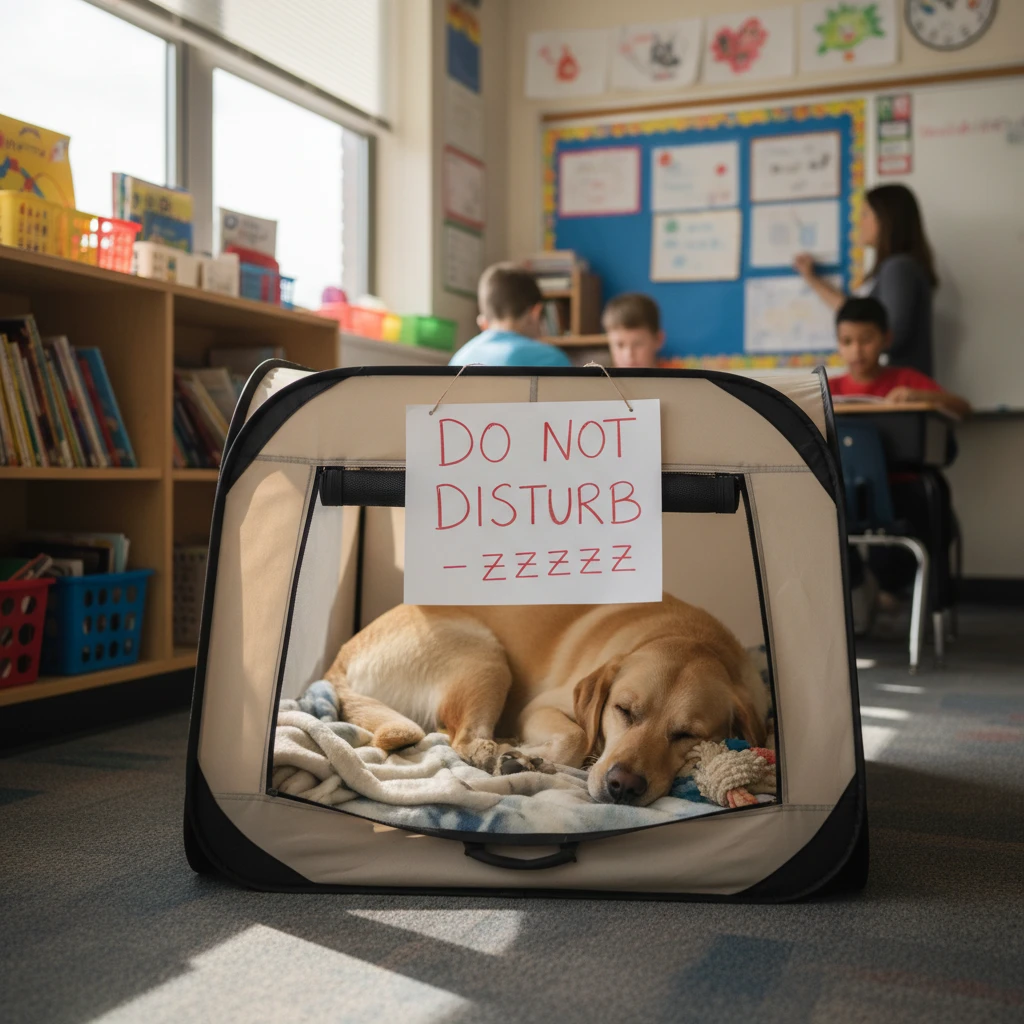
- Rest and Welfare: Ensuring the dog has a safe crate or quiet area and is not overworked. The SPCA advises strict limits on “working hours” for therapy animals.
- Handler Responsibility: Clearly defining who is responsible for the dog at all times.

The Health and Safety at Work Act 2015
Under NZ law, the dog constitutes a potential hazard that must be managed. A Risk Assessment Management system (RAMs) form must be completed. Risks to consider include bites, scratches, tripping hazards, and zoonotic diseases. However, these risks are mitigated through:
- Certification: Only using dogs that have passed the Canine Good Citizen test or specific therapy dog assessments.
- Insurance: Ensuring the school’s public liability insurance covers animal interactions.
- Consent: Obtaining explicit parental consent for student interaction with the dog.
Navigating MOE Funding and Grants
One of the most common questions is: “Does the Ministry of Education fund therapy dogs?” The direct answer is generally no; there is no specific “Therapy Dog Line Item” in the operations grant. However, funding can be accessed creatively by framing the dog as a resource for specific interventions.
Operations Grant and SENCO Budgets
Schools often use a portion of their Special Education Grant (SEG) to fund the training or ongoing costs of a therapy dog if it is directly linked to the Individual Education Plans (IEPs) of high-needs students. If the dog is an integral part of a behavioral management plan, the costs associated with its care during school hours can sometimes be justified as a learning resource.
Interim Response Fund (IRF)
In cases of severe behavioral challenges where a school might apply for the Interim Response Fund to keep a student engaged in education, a therapy dog program could theoretically be part of a broader package of support, though this is less common and requires strong advocacy from Ministry Psychologists or Resource Teachers: Learning and Behaviour (RTLBs).
External Community Grants
The most successful funding route for NZ schools is often through community gaming trusts and foundations. Organizations such as The Lion Foundation, Grassroots Trust, or the outcome-based grants from the Lottery Grants Board often look favorably on wellbeing initiatives.
Tips for Funding Applicants:
- Focus on Outcomes: Do not ask for money for “dog food.” Ask for funding for a “Literacy Engagement Program” or “Student Anxiety Reduction Initiative” where the dog is the vehicle for delivery.
- Provide Data: Use pilot data or international case studies to show the projected ROI in terms of student attendance and engagement.
- Community Partnership: Show that the community supports this. Letters of support from the PTA and local veterinarians can strengthen an application.

Back to School Support Strategies
The transition periods—specifically the start of Term 1 or returning after lockdown events—are peak times for student anxiety. This is where therapy dogs in schools NZ wide prove their immediate worth.
The “Gate Greeter” Role
School refusal is a growing issue in New Zealand. A therapy dog stationed at the school gate provides a powerful incentive for reluctant students to leave the car. The focus shifts from the anxiety of separating from parents to the excitement of seeing the dog. This “bridging object” technique is highly effective for junior primary students.
Settling into Classrooms
During the first weeks of school, establishing routines is critical. A therapy dog can be part of the morning circle time. For example, the “talking stick” can be replaced by the opportunity to pet the dog while sharing news. This lowers the affective filter of the classroom, making it a safe space for risk-taking in learning.
The Implementation Roadmap
Implementing a therapy dog program is a journey that takes 6 to 12 months. Rushing this process can lead to safety incidents and the cancellation of the program.
Phase 1: Feasibility (Months 1-2)
Survey the community. Gauge staff buy-in (not all teachers want a dog in their room). Identify potential handlers. Is there a staff member with a suitable dog, or will you contract an external provider?
Phase 2: Training and Certification (Months 3-8)
If using a staff member’s dog, this is the training phase. The dog should pass basic obedience and specific therapy dog assessments. In NZ, look for trainers who specialize in therapy work, not just obedience. The dog must remain calm around sudden noises, bells, and erratic movements typical of children.
Phase 3: Policy and Insurance (Month 9)
Finalize the RAMs forms. Check with the school’s insurer. Present the final proposal to the Board of Trustees for sign-off.
Phase 4: Soft Launch (Month 10)
The dog visits for short periods (e.g., 1 hour) when no students are present to get used to the environment. Then, introduce the dog to small, calm groups of students.
Phase 5: Full Integration (Month 11+)
The dog begins their regular timetable. Remember, a therapy dog should not work a full school day. They typically work 2-4 hours maximum with frequent breaks.
People Also Ask
Do you need a license for a therapy dog in NZ?
While there is no government-mandated “license” for therapy dogs in NZ, schools should require certification from a reputable organization (like Canine Friends Pet Therapy) or proof of passing the Canine Good Citizen test to satisfy health and safety obligations.
How much does a therapy dog cost for a school?
Costs vary significantly. If a staff member owns the dog, the cost may be limited to insurance, treats, and veterinary checks (approx. $1,000/year). Purchasing a fully trained assistance dog from a professional organization can cost upwards of $20,000, which is why most schools utilize staff-owned pets or volunteer visits.
What are the best breeds for therapy dogs in schools?
Temperament is more important than breed. However, Golden Retrievers, Labradors, and Poodles (often chosen for their hypoallergenic coats) are popular in NZ schools due to their generally calm and sociable nature.
How do schools handle students with dog allergies?
Schools manage allergies by creating “dog-free zones,” ensuring the dog is groomed to minimize dander, requiring students to wash hands after interaction, and restricting the dog from entering areas like the cafeteria or specific classrooms with highly allergic students.
Can a therapy dog help with school refusal?
Yes, therapy dogs are highly effective for school refusal. They act as a transition object, providing a positive, non-threatening motivation for the child to enter the school gates and separating the anxiety of leaving parents from the school environment.
What is the difference between a therapy dog and an assistance dog?
An assistance dog (like a guide dog) is trained to perform specific tasks for one individual with a disability and has legal access rights to all public places. A therapy dog is trained to provide comfort to many people and does not have the same automatic legal access rights to public spaces outside of their approved facility.