
Teacher training for canine assisted learning is a specialized professional development program designed to equip New Zealand educators with the skills to safely integrate therapy dogs into the classroom. It focuses on animal welfare, risk management, and pedagogical strategies to enhance student well-being and academic engagement through human-animal bond interventions.
Upskilling Staff for Canine Assisted Interventions
Implementing a school dog program requires significantly more than simply bringing a well-behaved pet onto school grounds. To ensure the program is effective, legal, and safe, staff members must undergo rigorous teacher training in canine assisted learning. This professional development bridges the gap between animal enthusiasm and clinical or pedagogical practice.
In the context of New Zealand schools, where student well-being (Hauora) is paramount, the introduction of a dog must be intentional. Training ensures that the handler—often a teacher or guidance counselor—understands the ethology of the dog and how to translate that into a learning environment. Without proper upskilling, schools risk negative incidents ranging from dog bites to student phobias, or simply an ineffective program that distracts rather than educates.
The Core Competencies of a CAL Handler
Professional training modules focus on several core competencies that transform a teacher into a Canine Assisted Learning (CAL) practitioner. These competencies include:
- Canine Body Language Decoding: Teachers learn to recognize subtle stress signals in dogs, such as lip licking, whale eye, or displacement behaviors. Recognizing these early prevents the dog from reaching a threshold where they might react defensively.
- Zoonotic Disease Management: Understanding hygiene protocols to prevent the transfer of illness between the animal and the students, a critical component of Health & Safety compliance.
- Intervention Design: Moving beyond “meet and greet” sessions to designing specific interventions that target literacy, emotional regulation, or social skills.
- Welfare Advocacy: The teacher must be the dog’s advocate. Training empowers staff to say “no” to interactions that compromise the dog’s well-being, modeling boundary-setting for students.
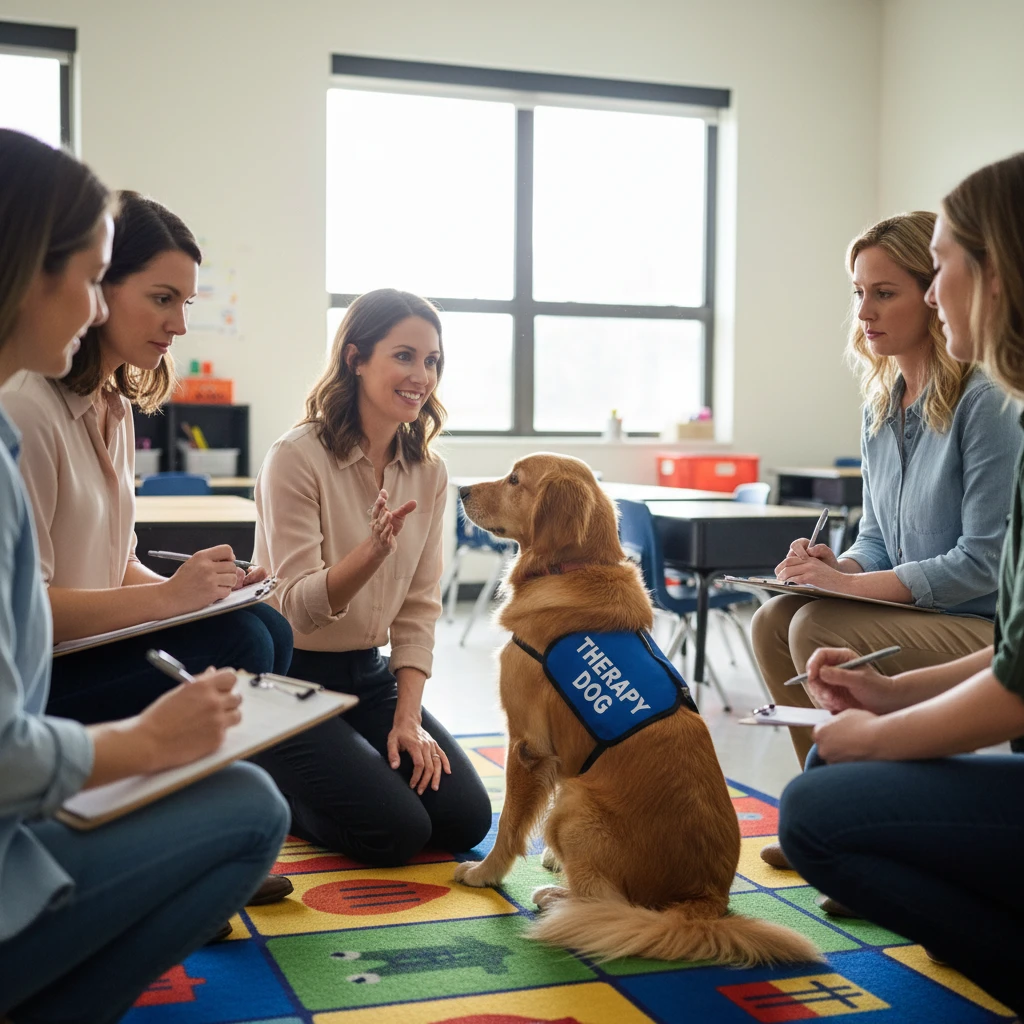
Classroom Management with a Dog
One of the primary concerns for principals and boards of trustees is how the presence of a dog will impact classroom dynamics. Effective teacher training for canine assisted learning addresses classroom management directly, turning potential distractions into powerful behavioral management tools.
Management strategies taught in our workshops rely on the concept of co-regulation. The dog serves as a bio-feedback mechanism for the class. If the noise level rises or the energy becomes chaotic, the dog is trained to retreat or show signs of unease. Teachers are trained to use this reaction as a teachable moment, asking students, “Look at Cooper; what is his body telling us about our volume right now?” This shifts the locus of control from the teacher’s authority to the students’ empathy.
Establishing Boundaries and Protocols
A structured environment is essential for CAL. Our training covers the implementation of strict protocols:
- The ‘No-Go’ Zones: Establishing physical areas in the classroom where the dog is not allowed (e.g., near lunches) and areas where students are not allowed (e.g., the dog’s crate or bed). The dog’s bed is a sanctuary; when the dog is there, they are ‘off the clock’.
- Interaction Rules: Teaching the “Ask, Wait, Pet” protocol. Students must ask permission, wait for the dog to approach, and then pet appropriately. This reinforces consent education.
- Managing Fear and Allergies: Not all students will be comfortable around dogs. Training provides strategies for inclusive practice, ensuring that students with cynophobia (fear of dogs) or allergies are kept safe and their needs respected without excluding them from the learning environment.

Curriculum Integration Ideas
The distinction between a “school pet” and “Canine Assisted Learning” lies in the curriculum integration. Our teacher training workshops provide concrete lesson plans and integration strategies that align with the New Zealand Curriculum.
Literacy and Reading Programs
The most common entry point for CAL is literacy support. Training covers how to set up a “Read to Dogs” program. The mere presence of a non-judgmental listener reduces performance anxiety in reluctant readers. However, training goes deeper, teaching educators how to use the dog as a character in narrative writing, or using the dog’s care requirements to teach procedural writing (e.g., “How to groom a dog”).
Social-Emotional Learning (SEL) and Hauora
In the New Zealand context, integrating the dog into Te Whare Tapa Whā models of health is highly effective. Training modules demonstrate how to use the dog to teach:
- Taha Wairua (Spiritual Health): Discussing the connection between living things and our responsibility as kaitiaki (guardians).
- Taha Whānau (Family Health): Building relationships and social skills. The dog acts as a social lubricant, making it easier for isolated children to interact with peers.
- Emotional Regulation: Using the dog’s heart rate and breathing to model self-soothing techniques.
STEM and Biology
Dogs provide a living laboratory for science. Teachers are trained to facilitate lessons on mammalian biology, nutrition, and behaviorism. Students can collect data on the dog’s activity levels or heart rate, integrating mathematics and statistics into real-world observation.

The New Zealand Context: Safety and Legislation
Operating a canine assisted learning program in New Zealand requires adherence to specific legislative frameworks. Our teacher training ensures that your school is compliant with the Health and Safety at Work Act 2015 and the Animal Welfare Act 1999.
Schools are considered workplaces (PCBU). Therefore, the introduction of a dog is a new hazard that must be identified, assessed, and managed. Our workshops guide school leaders through the creation of a robust Risk Assessment and Management Plan (RAMP). This includes insurance verification, vaccination tracking, and incident reporting protocols. Furthermore, we address the cultural considerations of dogs in schools, ensuring that tikanga Māori is respected. For some whānau, dogs may be viewed differently, and consultation with the community is a critical step covered in our strategic planning training.
Workshop Booking and Implementation
Investing in teacher training for canine assisted learning is an investment in the safety and success of your school’s well-being initiatives. We offer comprehensive workshop packages tailored to the specific needs of New Zealand schools.
Available Training Formats
We understand the time constraints on teaching staff. Therefore, our commercial offerings include:
- Full-Day Intensive (On-Site): A specialist trainer visits your school to work with the designated handler team and the dog in your specific environment. This includes a site assessment.
- Twilight Sessions: After-school professional development sessions for the wider staff to understand how to interact with the school dog.
- Online Certification Modules: Self-paced theory learning covering animal ethology, risk management, and curriculum design, followed by a practical assessment.
Our workshops are designed to move you from concept to implementation. Participants leave with a full policy framework, lesson plan templates, and a certified handler assessment.

Ready to Transform Your School Environment?
Don’t leave your school dog program to chance. Ensure your staff are upskilled, confident, and compliant. Contact us today to discuss your requirements and book a consultation for our Teacher Training Canine Assisted Learning packages.
Do teachers need a specific qualification to have a therapy dog in class?
While there is no single government-mandated qualification in New Zealand, operating without specific training exposes the school to significant liability under the Health and Safety at Work Act. Professional training and certification for the handler-dog team are industry best practices and often required by insurance providers.
How long does the teacher training take?
Initial intensive workshops typically last one to two days. However, full certification for a canine assisted learning practitioner often involves a combination of online theory (20+ hours) and practical assessments over several months to ensure the dog and handler are working safely together.
Can we use a teacher’s pet dog for this program?
Potentially, but the dog must pass a rigorous temperament assessment. Not all family pets are suitable for the high-stimulus environment of a school. The teacher must also undergo training to transition from ‘pet owner’ to ‘animal assisted intervention handler’.
What happens if a student is allergic to the dog?
Part of the training covers risk mitigation for allergies. This includes designating dog-free zones, using HEPA filters, maintaining strict grooming schedules to reduce dander, and ensuring students wash hands after interaction. The dog should never be forced on a student.
How much does a teacher training workshop cost?
Costs vary depending on whether the training is on-site or online. Generally, comprehensive school packages range from $1,500 to $5,000 NZD, which includes policy drafting, staff training, and dog assessment. Contact us for a specific quote.
Is this training recognized by the Ministry of Education?
The Ministry of Education does not accredit specific dog training providers. However, our training is designed to align with Ministry guidelines regarding health, safety, and curriculum delivery, helping schools meet their statutory obligations.